
A fail to move over or stop for emergency vehicle conviction can be viewed as a major-serious offence.
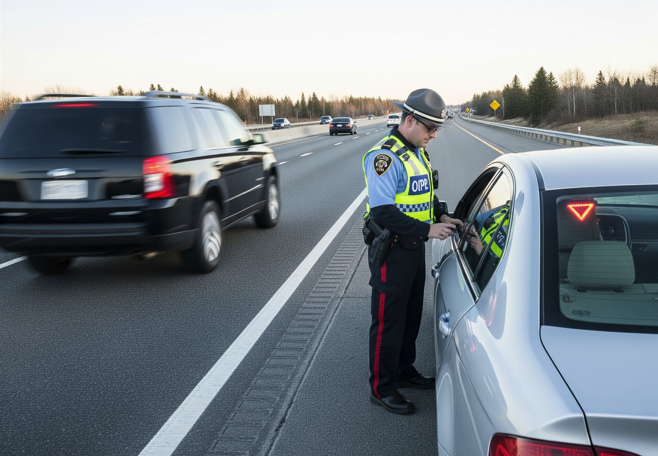
If you fail to move over or slow down for emergency vehicle(s) already stopped on the shoulder of the road a charge contrary to section 159(3) of the Ontario Highway Traffic Act will be laid if viewed by a peace officer. A large portion of these charges involve a police officer already engaging another driver on the highway.
What if I do fail to move over or slow down for emergency vehicle(s)?
More tickets in Ontario are issued for fail to move over or slow down for emergency vehicle than the public may be aware of. It is law in the province that, when approaching a stopped emergency vehicle, whether it be police, ambulance, fire & rescue, or even a tow truck, that the driver moves over into a new lane, or slows down significantly to prevent the emergency worker from being struck.
While the law dictates that one must move over or slow down for an emergency vehicle, part of the wording for this offence that is often omitted is that action taken “must be safe to do so.” This opens up more defences.
Fail to Move Over or Slow Down for Emergency Vehicle Penalties:
Court-imposed penalties;
- a monetary fine between $400.00 and $2,000.00, plus victim fine surcharge and court costs;
*Note the above fine is reserved if someone has been summonsed to court. If a less severe Part I charge has been laid the statutory set fine is $400.00, plus applicable costs.
A conviction will also guarantee the following MTO-imposed penalty;
- three (3) demerit points.
While the acquisition of three (3) demerit points may not appear overly severe, given the nature and wording of the charge, your insurance company may view you as a higher risk and elevate your premiums for safety concerns.
Defences:
Since this offence is designated as being one of strict liability, outside of the traditional “prove-it” defence, its classification allows the defendant to exculpate the offending behaviour on a balance of probabilities (tip the scale) if it can be demonstrated that reasonable care, attention, and/or action was taken to avoid the worst from taking place. In short, the strong defence of due diligence exists.